Anna Kin’s ღ project explores resistance to imperialism through language
The installation “ღ” (‘ghani’) by Kazakhstani artist Anna Kin was presented in Berlin in September 2025 at “Hotel Continental – Art Space in Exile.” Put together by Azerbaijani curator Zuleykha Ibad and Kazakhstani producer Lev Tarikov, the artistic project is titled after a letter of the Kartvelian alphabet, as it playfully echoes the shape of a heart and places an affective dialogue on language politics in transition.
In January 2025, Kazakhstan planned yet another transition to the Latin alphabet—the fourth amendment of its script in a century. Written in Old Turkic script until the 11th century, Kazakh was written in the Arabic script following the spread of Islam. The Latin alphabet was briefly introduced in 1929, before it was turned to a Cyrillic version.
Since 2017 Kazakhstan has been moving once again towards a Latin alphabet, a process plagued with constant delays. Kazakhstan’s society is divided on the issue, with some viewing it as a path to modernization while others fear losing the current written heritage.
This raises questions, partially addressed in the artist’s work: How often has history been reinterpreted before the arrival of "New Kazakhstan"? Does this mean that information in Latin script, written by contemporary academics, will be truer? And, more importantly, will this transition help in better understanding oneself and others on a humanitarian level?
From this context, Kazakhstani artist Anna Kin conceived of the “ღ” project. The name comes from the only unchanged symbol remaining after all the Kartvelian alphabet reforms. It evokes a distinct sense of consistency in a transforming environment. A visible, radical, immutable change to the whole semiotic space around it.
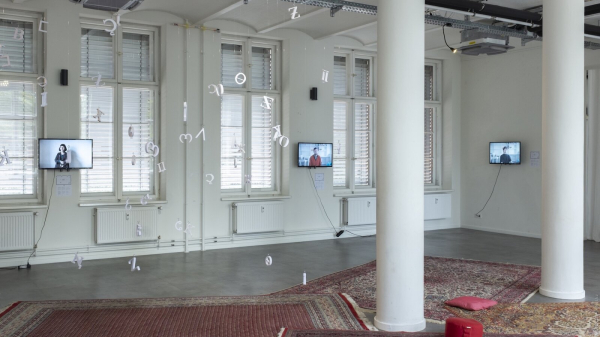
The project constitutes a total installation—a space filled with the sounds of thirteen alphabets. Macedonian, Lak, Azerbaijani, Georgian, Nogai, Serbian, Albanian, Berber, Ukrainian, Farsi, Lezgin, Mari, Balkar. All languages sound simultaneously, creating a polyphony of voices. Attendees can listen to a general soundscape or choose individual stories through headphones: interviews with descendants of the deported, stories about lost languages, memories of forced relocations of the 1930s-40s. Letters suspended in space tremble from air movement created by visitors, representing how language comes alive through the people that use it.

Why these languages specifically, and why now, during this new drive towards Latinization? The answer lies in the very nature of alphabet reforms, which are never merely technical modernization. The Soviet project of the 1920s-30s for the latinization of Turkic languages was presented as liberation from “Arab feudalism” and a path to international proletarian unity. The real goal was different: to sever ties with the Islamic world, Ottoman heritage, to create “new people” without memory of the pre-Soviet past.
The cyrillization of the 1940s followed the same logic but with the opposite sign. Latin suddenly became “bourgeois,” whereas Cyrillic was considered a sign of joining the “great Russian culture.” Within a decade, the possibility of reading the recent past was crossed out twice. The end goal was to ultimately create a generation of people without roots, wholly dependent on the state for interpreting their own history.
The contemporary latinization plan in Kazakhstan speaks to efforts of decolonization–separation from Soviet heritage and integration into the global world–but simultaneously severs the connection between generations. Once language continuity is broken, the process of knowledge transmission becomes ever more difficult, and reading texts originally written in the old script becomes challenging.
Alphabet reforms are only part of Kazakhstan’s tragic history. Alongside them came the mass deportation of “untrustworthy” communities to Kazakhstan and Central Asia. Around 172,000 Koreans were deported there from the Far East in 1937, and in 1941, 444,000 ethnic Germans from the Volga region of Russia followed them into exile. Between 1943-1944, Chechens, Crimean Tatars, Pontic Greeks, Bulgarians and many other groups were all similarly exiled on Stalin’s orders. By 1945 more than 1.2 million deportees resided in Kazakhstan, nearly a quarter of the republic’s population.
Every deportation was not only a human tragedy, but a linguistic catastrophe. Ripped from their homelands and strewn across the steppe, without any schools for their native languages, the deportees lost their mother tongues within a couple of generations. On the Kazakh steppe, their languages became sounds nobody could understand and symbols nobody could interpret. The Koreans sent to Kazakhstan in 1937 now do not speak Korean. The Volga Germans, who once lived in an autonomous republic with German-speaking schools, became a Russian-speaking diaspora.
It is important to recognize the difficult position of native Kazakhs during this. They accepted the deportees, themselves having experienced massive population upheavals. From 1930 to 1933, famine killed between 38-42% of the total Kazakh population. This creates a unique constellation: People who survived their own catastrophe become involuntary witnesses and participants in the catastrophes of others. Not by their own will, not as aggressors, but as fellow victims of the empire.

Born in Almaty, Anna Kin works precisely with this complex position. In this new project, she wanted to explore the shared experience among displaced communities: non-titular ethnic groups and their heritage. To deliver the statement against the idea of a singular narrative, Kin has created a space in which multiple different voices are heard at once. The thirteen languages in her installation are united through their solidarity, which is based not on their linguistic or ethnic similarity, but on their shared encounter with imperial violence.
To display her idea, Kin initially set out to create an audio archive, which intended to help descendants of these languages pass on the knowledge of these alphabets through an emphasis on pronunciation.
“Some of these languages are losing popularity, disappearing even. Their sound must be preserved,” Kin said in an interview with Ani Menua. During her fieldwork, where she spoke to descendants of the deported and representatives of diasporas, Kin said she understood language to be a glimpse into the deeper loss of entire worlds, ways of life, connections to land and history. Here the project transformed from documentary to affective. Instead of creating an “objective” archive, Kin began working with emotional resonance.
The choice of languages is particularly interesting, going beyond tragic Soviet deportations, focusing on languages still under threat today. Through a transnational framework, i.e. by including Lezgin and Lak, which are marginalized in contemporary Russia, Tifinagh that fights for recognition in North Africa, Nogai is under threat of extinction, activists of Mari language revival face repression. In her research-driven project, Kin demonstrates that language deprivation is not a uniquely Soviet practice, rather that it is a universal tool used by almost all empires to exercise control. The project is not a catalogue of dead languages—it witnesses ongoing violence.


Heard together, the simultaneous sounding of all alphabets creates not an informational but a sensory space in which individual voices are lost and found, just as the deported lost and found each other in the Kazakhstani steppes.
The context of the project’s creation is critically important. Between 2023-2025, Kazakhstan experienced a paradoxical cultural boom as the political sphere tightened. The art scene is developing, international exhibitions have taken place and a new museum and a center of contemporary culture have opened in Almaty. Simultaneously, the list of political prisoners grows, journalists have been detained on charges of “dissemination of false information.” This context is important for understanding the exhibition and its message.
A strength of the project is its refusal to take a black-and-white stance. Kin is not trying to romanticize the past nor to demonize the present. Deported populations suffered under the Soviet regime, but some of them took part in colonizing Kazakhstan in the 19th century and the Russian language was indeed an instrument of imperial dominance.
In a country where every power transition promises a fresh start, inconvenient history is silenced and collective amnesia is a condition for survival, Project “ღ” is an invitation for a critical memory, that is the ability to hold multiple perspectives simultaneously, to recognize history’s complexity, to learn from mistakes without repeating them.
The Kartvelian letter “ღ”, which gives the project its name, is an island of consistency in a sea of transformation. Perhaps this detail contains the main message of the project: the quiet persistence of conversation. In remembering names, sounds, stories. In creating spaces where different voices can sound simultaneously without drowning each other out.
Kin’s project is an act of faith that memory is stronger than forgetting, that somewhere between lost alphabets and new reforms exists a space for genuine dialogue. A space where history does not begin with the latest decree but continues through all ruptures and transformations, preserving the connection of times.
An edited version of this article, first published in Russian, was translated by Will Stringer.
Власть — это независимое медиа в Казахстане.
Поддержите журналистику, которой доверяют.
Мы верим, что справедливое общество невозможно построить без независимой журналистики и достоверной информации. Наша редакция работает над тем чтобы правда была доступна для наших читателей на фоне большой волны фейков, манипуляций и пропаганды. Поддержите Власть.
Поддержать Власть